
OPENING QUESTIONS: What information can we obtain simply by looking at the graph below (WITHOUT doing any math):
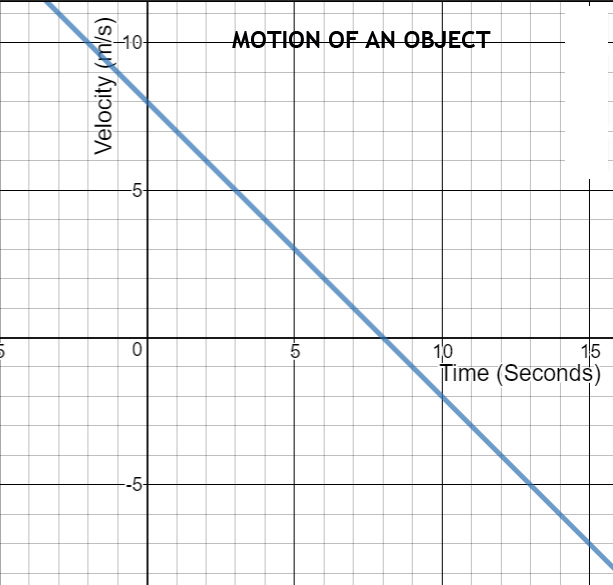
- Describe the motion of that object in a full sentence.
- What was the average velocity of the object at anytime?
- What was the instantaneous velocity of the object at ANY time? Why?
- What was the displacement of the object between 5.0 seconds and 8.0 seconds?
- Now let's get a bit more....hmmm...devious? What was the displacement of the object between 0.0 seconds and 15. seconds? What did you learn from analyzing THAT motion (hint: what do we mean by area 'under' a curve?)
(5 min)
OBJECTIVES:
I will recognize and use the basic equations of motion during today's class
WORDS O' TODAY:
- DISPLACEMENT (distance & direction)
- Distance
- VELOCITY (displacement/time)
- Speed (distance/time)
- ACCELERATION (velocity/time)
FORMULAE OBJECTUS:
0) vt=x
1) vf = vi +at
2) vavg = (vi + vf)/2
3*) xf = xi + vit + 1/2at2
4*) vf2 - vi2 = 2a∆x
WORK O' THE DAY:
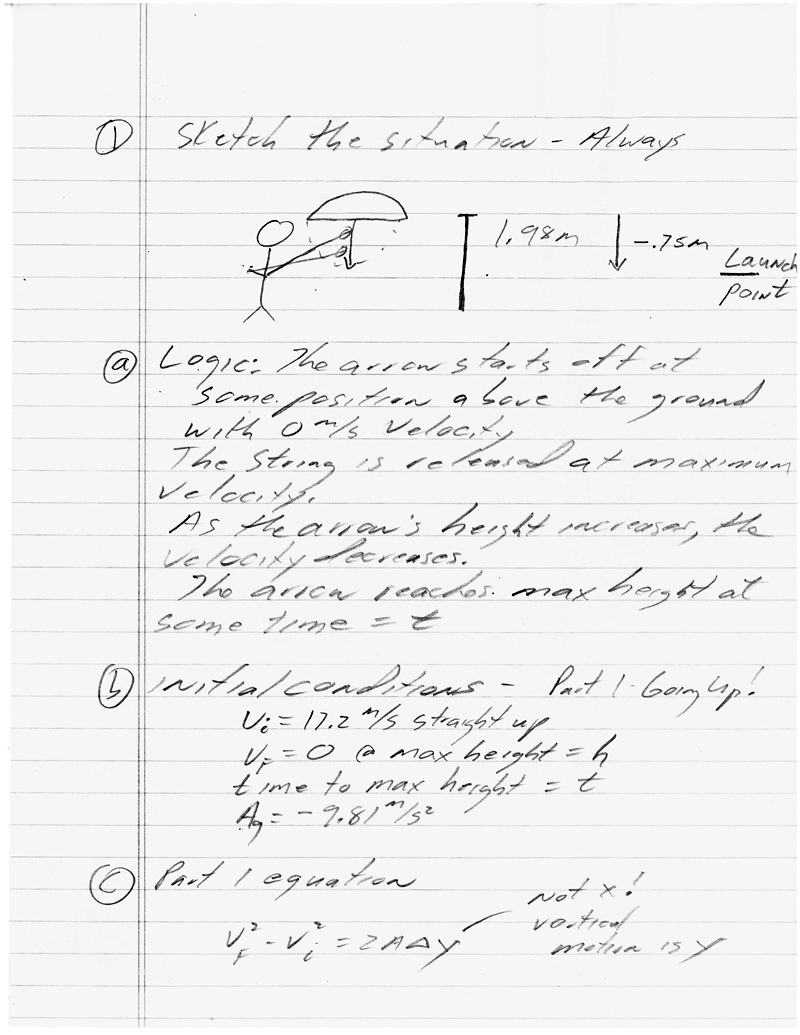
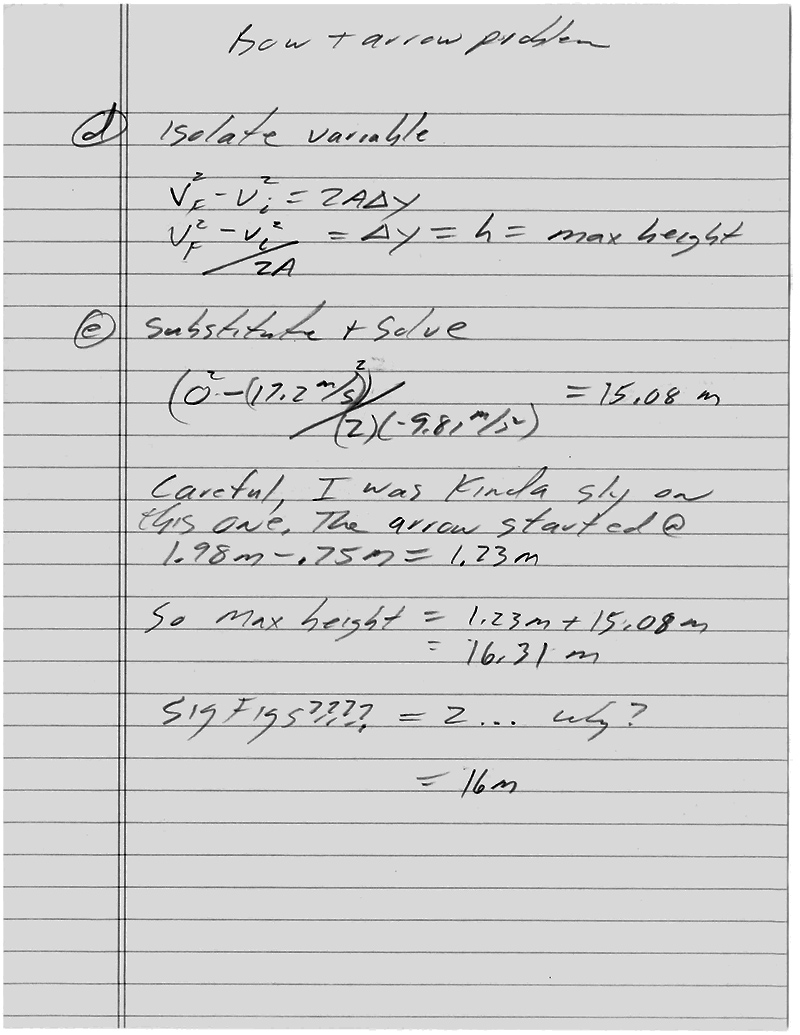
Occasionally I'll ask you to provide THIS level of detail for solving a problem (I tossed this one at you last Friday):
Let's take a gander at the the 'quick test' thingy:
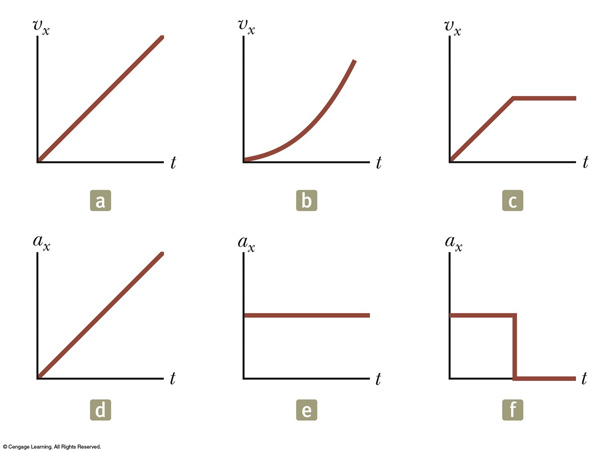
While you're first working through those, DO NOT GUESS. Take some actual data to assure yourself that your assumptions are accurate:
- a quick derivative might help
- a full sentence description is ALWAYS helpful
Try that now
Now stress your learning a bit and go BACKWARDS from d, e and f....
(5-8 min)
══════════════════════════
Before we mush on...
Let's please review that odd nuclear fission question I tossed at you over the weekend. Have a conversation with your group on how you might APPROACH dealing with a problem that stumps you in such a fashion....
Here's something I will emphasize this year--
There will be plenty of times where:
- You know the question/problem
- You know the answer to the question/problem
- You don't understand how to get from the question to the answer
- Building a 'bridge of understanding' between the question and the answer is a fantastic skill to develop (rather than just looking up the answer). Learning how to build that bridge, getting used to doing that makes you a *formidable* student... (which of course is my goal for all of you!)
(10 min)
══════════════════════════
We're winding down our conversations of one dimensional motion so....
1) Please recite our equations of motions as quickly as you can
2) What MUST be true in any equation using acceleration?
3) How is vertical motion evaluated differently from horizontal motion?
(2-3 min)
══════════════════════════
Imagine an object is dropped from the ceiling of our classroom (height = 2.76 meters). How long will it take to hit the floor?
- Describe the particular in how we will evaluate that motion
- Do a FULL Wolgemuthian on that now:
- Sketch & Label all relevant info
- List initial conditions
- List relevant formulae
- Isolate the information we're looking for
- Substitute variables
- Solve
(6-8 min)
══════════════════════════
Imagine that we have an object sliding across a frozen pond that is subject to some sort of force such that it experiences a constant acceleration of 2.376 m/s2. Where will that object be (relative to the origin) in 13.2 seconds?
- What is the relevance of the surface being frozen?
- Do a full wolgemuthian on that one but do not solve (for now)
(6-8 min)
Now let's have some fun with THIS beastie:
══════════════════════════
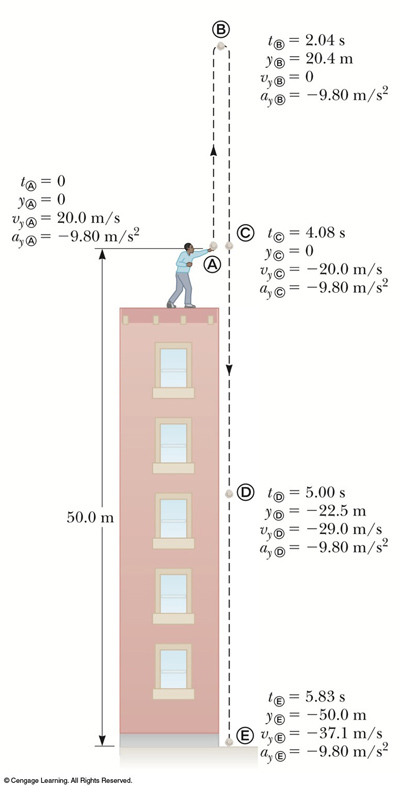
Consider the case of a ball thrown from the top of a building as shown above.
If we are to evaluate this problem in terms of one dimensional motion ONLY, what assumption MUST we make about the motion of the ball?
Remember -- We ALWAYS break vertical motion problems into two parts:
- An object's vertical velocity begins at vmax and decreases to 0.0 m/s when it reaches hmax
- A falling object begins with vmin = 0.0 m/s at hmax and falls until it hits the ground.
- A falling object experiences vmax at a tiny, infinitesimal moment just before it hits the ground.
- People designated by the color Orange:
1) What goes up...
2) Must go down...
- Please write out a strategy for dealing with finding the time launch and position of the ball at point B
- People designated by the color Green:
- Please write out a strategy for dealing with finding the time after launch, position and velocity of the ball at point C
- People designated by the color Red:
- Please write out a strategy for dealing with finding the position and velocity of the ball at point D if the ball arrived at position D 5.00 seconds after it was thrown upwards.
- People designated by the color Blue:
- Please write out a strategy for dealing with finding the time after launch and maximum velocity of the ball at point E
Finish this at home if we don't get it knocked out today...
HOMEWORK:
-
Coordinate with your groupies on collecting their ideas on finding displacement and time values for B, C, D & E....
-
Solve for each
-
Finish the frozen pond problem
- Take a look at THIS animation